Tuya Smart Baby Monitor – 5-Inch HD Display with APP Control, SD Card Storage & Two-Way Audio
Short Description
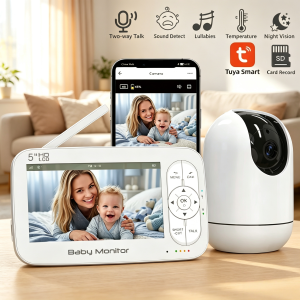
Tuya Smart Baby Monitor with 5-inch HD display, 1280×720 resolution, two-way audio, cry detection, lullabies, temperature monitoring, and night vision. Supports Tuya Smart APP for remote viewing, SD card storage (8-128GB), and WiFi/No-WiFi dual modes. Multi-user sharing, split-screen feature, and 2x/4x digital zoom.
Product Description
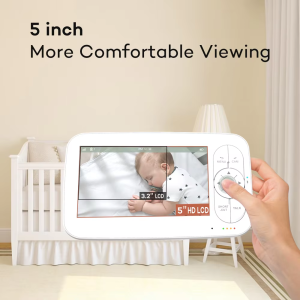
Stay connected with your baby anytime, anywhere with the Tuya Smart Baby Monitor. Featuring a large 5-inch HD display, intelligent cry detection, and flexible connectivity options — use with or without WiFi, with or without the APP.
Key Features
5 Core Functions for Complete Baby Care:
Feature
Description
🎤 Two-Way Talk
Built-in microphone and speaker for crystal-clear communication
😢 Sound Detect
Smart cry detection with instant VOX mode alerts
🎵 Lullabies
Soothing sounds and white noise to calm your baby
🌡️ Temperature
Real-time room temperature display (°F/°C)
🌙 Night Vision
Automatic infrared LEDs for clear video in darkness
💾 SD Card Storage
Local recording with 8-128GB micro SD card support
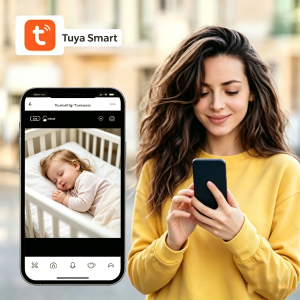
📱 Tuya APP
Remote viewing via Tuya Smart APP
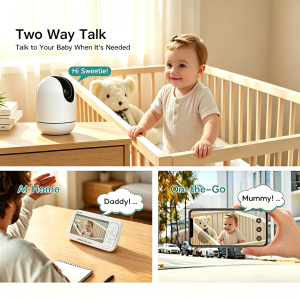
Two-Way Talk – Stay Connected Anytime
Talk to your baby from anywhere in the house or on-the-go. The Tuya Smart Baby Monitor features high-sensitivity microphone and speaker for crystal-clear two-way audio communication.
Key Benefits:
Strong 2.4GHz signal connection
No delay, real-time communication
Comfort your baby remotely at home or away
“Hi Sweetie!” – Talk to your baby instantly
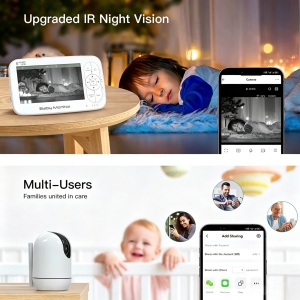
Upgraded IR Night Vision
Sleep Mode – Monitor your baby with audio-only mode for peaceful nights.
Upgraded IR Night Vision – Automatic infrared night vision ensures you can see your baby clearly even in complete darkness. The 5-inch HD display shows every detail, day or night.
Multi-Users – Families United in Care
Share access with family members! The Tuya Smart APP allows multi-user sharing, so grandparents, parents, and caregivers can all monitor the baby from their own devices.
Add Sharing Options:
Share with Account
Share with Others (WeChat, Messages, Copy Link)
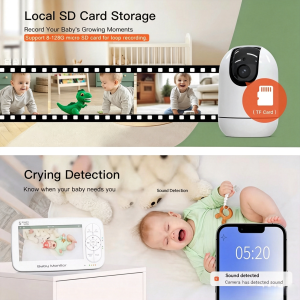
Local SD Card Storage
Record Your Baby’s Growing Moments
Support 8-128GB micro SD card for loop recording. Never miss a precious moment — save videos locally and review them anytime.
Automatic loop recording
Local storage, no cloud fees
Easy playback on parent unit or APP
Crying Detection – Know When Your Baby Needs You
Smart sound detection alerts you instantly when your baby cries. The Tuya APP sends push notifications to your phone, so you’re always connected.
Sound Detection Alert: “Camera has detected sound” at 05:20
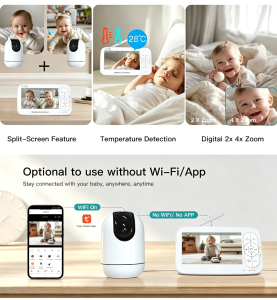
Split-Screen, Temperature & Zoom
Feature
Description
Split-Screen Feature
Monitor multiple cameras on one screen
Temperature Detection
Real-time room temperature (28°C shown)
Digital 2x 4x Zoom
See every detail with digital zoom
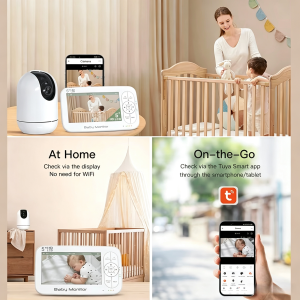
Optional to Use Without Wi-Fi/App
Flexible Connectivity Options:
Mode
Connection
Use Case
WiFi On
Tuya Smart APP + WiFi
Remote viewing from anywhere
No WiFi / No APP
Direct monitor connection
Simple plug-and-play at home
Stay connected with your baby, anywhere, anytime — with or without WiFi.
Specifications
Specification
Details
Display Size
5 Inch HD LCD
Resolution
1280 × 720 HD (720P)
APP Support
Tuya Smart APP (iOS & Android)
WiFi Support
Yes, 2.4GHz WiFi
SD Card Storage
8-128GB micro SD card (TF Card)
Wireless Range
Up to 300 Meters (direct mode)
Night Vision
Upgraded IR Night Vision
Temperature Display
°F / °C
Zoom
2x / 4x Digital Zoom
Multi-User
Yes, via Tuya APP
Split-Screen
Yes, supports multiple cameras
Two-Way Audio
Yes, built-in microphone & speaker
Cry Detection
Yes, with push notifications
Lullabies
Yes, built-in soothing sounds
Battery
Rechargeable (capacity varies by model)
What’s in the Box
1 × Parent Unit (5-Inch Monitor)
1 × Baby Unit (Camera)
2 × Power Adapters
1 × User Manual
Perfect For
Newborn nursery monitoring
Toddler sleep supervision
Nanny/babysitter monitoring
Travel and vacation use
Multi-room home coverage
Elderly care
Pet watching
Families who want flexible viewing options (APP or no APP)
Give yourself peace of mind and give your baby the best care with this professional-grade smart baby monitor system.
How to Choose an Outdoor Security Camera in 2026: Don't Blind Yourself to the Truth
One blind spot. One missed threat. One decision that could cost you everything.
Wait — Is Your Security Camera Actually Securing Anything?
Let's confront an uncomfortable reality.
You've installed a security camera. You've got the app on your phone. You sleep soundly believing your property is protected. But here's the question that keeps security professionals awake at night:
How many blind spots does your camera have?
In 2026, the average outdoor camera leaves 40% of its coverage area in shadow — not literal shadow, but surveillance shadow. That corner where your garage meets the fence. The pathway behind your shed. The side entrance that delivery drivers use. All invisible. All unprotected.
A single-lens camera, no matter how high its resolution, is fundamentally limited by physics. One lens. One angle. One point of failure.
So before you buy another "4K security camera" that leaves half your property exposed, let's talk about what actually matters in 2026.
The 2026 Outdoor Camera Checklist: What Really Matters
1. Dual Lens Technology: Two Eyes Are Better Than One
The biggest innovation in 2026 security cameras isn't 8K resolution or AI recognition — it's dual lens systems.
Here's why single-lens cameras fail:
Fixed perspective — one angle, one field of view
Zoom vs. wide angle dilemma — zoom in and lose periphery; go wide and lose detail
Blind spots by design — physics doesn't compromise
Dual lens cameras solve this permanently:
Tuya 8MP Dual Lens Security Camera – Ultra HD Outdoor Surveillance Dual Lens Technology – Two Views One Camera
Lens 1: Wide-angle overview — captures the full scene, detects motion across your entire property
Lens 2: Zoom/detail lens — automatically tracks and focuses on threats, delivering facial recognition-level detail
One device, two perspectives — no more choosing between coverage and clarity
The 2026 standard: If your outdoor camera doesn't have dual lenses, you're buying yesterday's technology.
2. True 360° Coverage: Pan, Tilt, and No Compromise
A camera that doesn't move is a camera that misses things. Period.
Minimum requirements for 2026:
Horizontal rotation: 355° — nearly full circle coverage
Vertical rotation: 75° — from ground level to roofline
Auto-tracking: Camera follows moving objects automatically
Preset patrol routes: Program specific paths for periodic scanning
Why this matters: A static camera catches what happens in its frame. A PTZ (Pan-Tilt-Zoom) camera catches what happens, period.
3. Night Vision: Color or Nothing
In 2026, "night vision" doesn't mean grainy black-and-white footage anymore. It means full-color night vision.
The evolution:
2019-2022: Infrared black-and-white — identifiable, but detail-poor
2023-2024: Starlight sensors — better low-light, still monochrome
2025-2026: Full-color night vision — daytime clarity, midnight conditions
What to look for:
Dual-light system — infrared for invisible illumination, white LED for color capture
Large aperture — F1.6 or wider (lower number = more light)
Advanced ISP — image signal processing that reduces noise without smearing detail
If your camera still switches to black-and-white at night, it's time to upgrade.
4. Weather Resistance: IP66 Is the Floor, Not the Ceiling
Outdoor cameras live in a hostile environment. Rain, dust, snow, direct sunlight, temperature swings from -10°C to 60°C.
2026 weatherproofing standards:
IP66 minimum — dust-tight, protected against powerful water jets
IP67 preferred — can survive temporary immersion
Operating range: -20°C to 60°C for northern climates, -10°C to 60°C standard
Lightning protection — surge protection for power and network lines
UV-resistant housing — won't degrade or discolor in direct sun
Pro tip: Check the actual operating temperature range, not just the IP rating. A camera that dies at -5°C is useless in Chicago winters.
5. Connectivity: 5G WiFi + PoE = Reliability
Wireless cameras are convenient. Wired cameras are reliable. In 2026, you shouldn't have to choose.
The ideal setup:
5G WiFi 6/6E — for wireless installations with maximum bandwidth
PoE (Power over Ethernet) — single cable for power and data, no WiFi congestion
Dual-band fallback — 2.4GHz when 5G signal is weak
Local storage + Cloud — SD card for local backup, cloud for off-site security
Avoid: Cameras that only work on 2.4GHz WiFi — increasingly congested and prone to interference.
6. Smart Detection: Not All AI Is Created Equal
"AI-powered detection" is marketing speak in 2026. Here's what actually works:
Essential detection types:
Human detection — distinguishes people from animals, vehicles, shadows
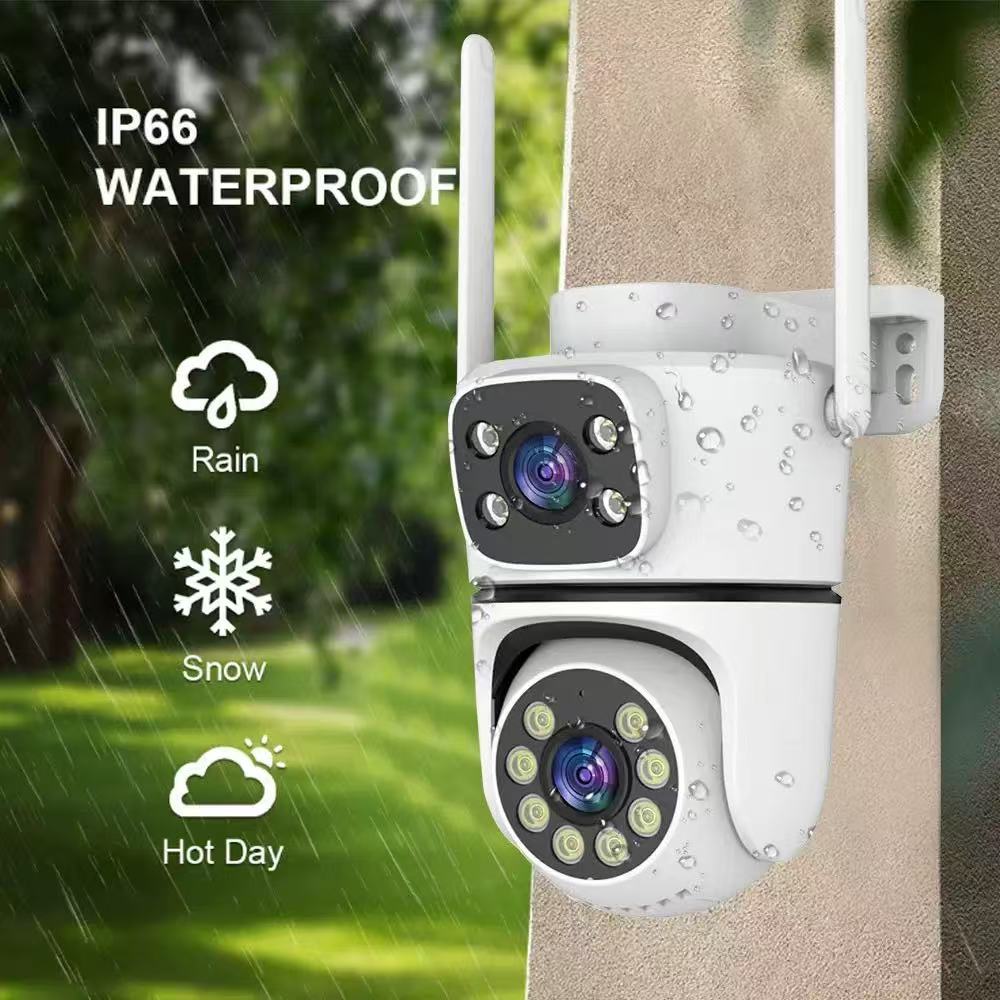
IP66 Weatherproof – Built for Outdoor Extreme Conditions
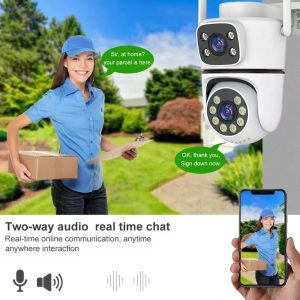
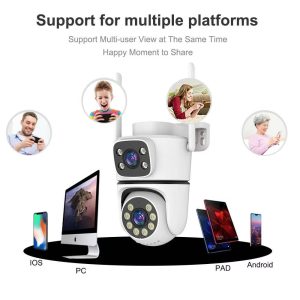
Two-Way Audio – Real-Time Voice Communication Multi-Platform Remote Access – Any Device, Anywhere
SD Card (Local)
No subscription, works offline
Limited capacity, physical theft risk
Cloud
Off-site backup, easy sharing
Subscription cost, bandwidth usage
NVR/DVR
Massive capacity, professional grade
Higher upfront cost, complex setup
Hybrid
Best of both worlds
Slightly more complex
Our recommendation: Hybrid. SD card for immediate local recording, cloud for backup and remote access. If someone steals the camera, you still have the footage.
The Hidden Costs of Cheap Cameras
Before you buy that $29 "4K security camera" from an unknown brand, consider:
Subscription traps — $5-15/month for basic features
Data privacy — who's watching your footage? Where is it stored?
App quality — buggy apps that crash when you need them most
Support — no customer service when something breaks
Lifespan — cheap cameras die in 6-12 months outdoors
Real cost of a "cheap" camera over 3 years:
Camera: $29
Subscription: $15/month × 36 months = $540
Replacements (2x): $58
Total: $627
Quality camera, no subscription, 3-year warranty:
Camera: $199
No subscription
No replacements
Total: $199
Math isn't hard. Quality pays for itself.
So, What's the Answer? Two Lenses. One Device. Zero Blind Spots.
After testing dozens of outdoor cameras across every price point, the conclusion is unavoidable: dual lens technology isn't the future — it's the present.
Single-lens cameras are compromise devices. They force you to choose between wide coverage and detail zoom. Between overview and inspection. Between seeing the threat and identifying it.
Dual lens cameras refuse that compromise.
This is where the Tuya-powered dual lens security camera approach stands apart in 2026. Instead of one lens trying to do everything, it uses two specialized lenses working in harmony:
Wide-angle lens (8MP): 355° panoramic coverage — sees everything happening across your property
Detail lens (8MP): 10× digital zoom with auto-tracking — locks onto threats and delivers identification-grade clarity
Both recording simultaneously — never miss the big picture or the critical detail
The technical foundation:
3264×2448 resolution — true 8MP clarity, not upscaled 4MP
CMOS sensor with backlit compensation — handles challenging light conditions
F4.0 aperture with full-color night vision — see faces, license plates, and colors at midnight
IP66 weatherproofing — survives rain, dust, snow, and temperature extremes
5G WiFi + PoE dual connectivity — wireless flexibility or wired reliability, your choice
Two-way audio with noise cancellation — crystal clear communication in any weather
But the real differentiator? The ecosystem.
This isn't just a camera — it's a node in the Tuya smart home network. Connect it to:
Smart door locks — see who's at the door, unlock remotely
Motion sensors — trigger recording before motion reaches the camera
Smart lights — floodlights activate when camera detects intrusion
Alarm systems — 110dB siren triggers automatically or manually
Smart displays — view camera feed on kitchen or living room panels
Everything works through one app. One interface. One system.
Final Verdict: What Should You Buy in 2026?
If you have a small property (apartment, townhouse):
A single dual-lens camera at the main entrance covers 80% of your needs. Add a second for the rear if accessible.
If you have a medium property (suburban home, small business):
Two dual-lens cameras — front and rear — with overlapping coverage zones. The auto-tracking feature means one camera can monitor multiple entry points.
If you have a large property (estate, farm, warehouse):
Three to four dual-lens cameras at key positions, supplemented by fixed cameras for perimeter coverage. Use the PTZ cameras as "active" responders and fixed cameras as "passive" recorders.
If you care about privacy:
Demand local storage options, end-to-end encryption, and clear data policies. Tuya's platform supports local SD recording with optional cloud backup — your choice, not forced.
If you want it to just work:
Choose a camera with broad smart home compatibility. Tuya works with Alexa, Google Home, SmartThings, and thousands of third-party devices. No vendor lock-in.
The Bottom Line
Choosing an outdoor security camera in 2026 isn't about megapixels or brand names. It's about eliminating blind spots — both physical and technological.
Ask the hard questions:
Does this camera see everything I need it to see?
Can it identify a face at 20 meters, day or night?
Will it survive my local weather for 3+ years?
Can I access footage without paying a monthly ransom?
Does it work with the smart home devices I already own?
Get those answers right, and your camera becomes a guardian, not just a gadget.
Two lenses. One device. Zero blind spots. One decision that protects everything.
What's your current security setup? Are you still relying on single-lens cameras, or have you upgraded to dual-lens technology? Share your experience in the comments — I'd love to hear what's working (and what isn't) in your area.
Ready to eliminate your blind spots? Explore the full range of Tuya-powered dual lens security cameras and find your perfect fit.
Location: Shenzhen, China — Global shipping available
From 8MP dual-lens PTZ cameras to complete smart home security systems — all built on the Tuya ecosystem with One Screen One System integration.
About the author:Security technology consultant and smart home integrator with 10+ years of experience designing surveillance systems for residential and commercial properties. Currently maintaining a 24-camera setup across three locations — all dual-lens, zero blind spots.